From majestic humpback whales and towering musk ox to elusive polar bears and resilient Arctic foxes, Greenland is home to some of the Arctic's most extraordinary wildlife. Its dramatic fjords, vast ice sheet and rugged coastlines provide the perfect habitat for an incredible variety of marine mammals, birds and land animals. Whether you're exploring by expedition ship or cruising along Greenland's spectacular coastline, every day offers the chance for unforgettable wildlife encounters. Here's your guide to some of the remarkable species you might spot on your Greenland cruise.
Polar Bear
Common Name: Polar Bear
Scientific Name: Ursus maritimus
Type: Marine Mammal
Diet: Carnivore
Size: Adult males are typically up to 10 feet tall, while females range between 6 and 8 feet
Weight: Adult males weigh up to 1,430 pounds, and females weigh up to 770 pounds
Few animals are as closely associated with Greenland as the polar bear. Built for life among Greenland’s drifting sea ice, these extraordinary creatures are equally at home on land and in the water, capable of swimming for days using their powerful front paws. Beneath their white-looking coats, their skin is actually black, helping them absorb heat, while the thick fur covering the soles of their feet provides insulation and grip as they move across the ice. Throughout the year, polar bears rely on the frozen landscapes to hunt seals, with only pregnant females retreating to snow dens during winter to give birth. Their tiny cubs, often weighing little more than a pound at birth, remain with their mother for more than two years, learning the skills needed to survive in this unforgiving environment. While spotting a polar bear on a Greenland cruise is possible, sightings are rare and can never be guaranteed. They are most likely to be seen in the remote north and north-east of Greenland, where sea ice remains for much of the year. As Arctic sea ice continues to shrink, polar bears face increasing challenges, making the opportunity to witness one in its natural habitat even more extraordinary.
Humpback Whales
Common Name: Humpback whales
Scientific Name: Megaptera novaeangliae
Type: Marine Mammal
Diet: Carnivore
Size: Adult humpback whales generally measure between 40 and 60 feet
Weight: Between 50,000 and 80,000 pounds
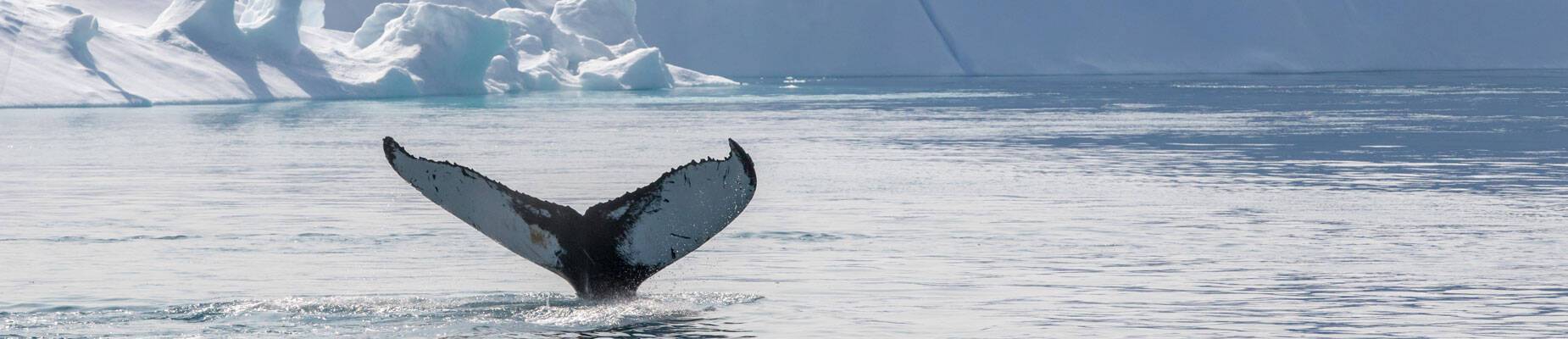
Highly intelligent and impressive in size, humpback whales are among Greenland’s most spectacular wildlife sightings. They visit the country’s nutrient-rich fjords each summer to feast on vast quantities of krill and small fish, with the best opportunities to spot them typically falling between July and September, although they can occasionally arrive as early as April and remain until November. During this relatively short feeding season, a single humpback can consume up to 900 kilograms of food each day, building the blubber reserves needed to sustain it throughout the rest of the year. One of their most fascinating behaviours is bubble-net feeding, a remarkable co-operative hunting technique in which groups of whales release spirals of bubbles to trap shoals of fish before lunging upwards through the centre. Although they gather to feed, migrate and breed, humpback whales have a fluid social structure and spend much of their lives alone. The only lasting social bond is between a mother and her calf, who typically remain together for around a year. These gentle giants are among the world’s greatest travellers, undertaking migrations of up to 5,000 miles between Greenland’s polar feeding grounds and the warm breeding waters of the Caribbean. Male humpbacks are famous for their haunting songs, which can travel for miles beneath the ocean’s surface and are thought to help attract mates and communicate with other whales. Humpback whales also play a vital role in maintaining healthy marine ecosystems by recycling nutrients from the deep ocean to the surface through their feeding and diving behaviour. While adults have few natural predators due to their enormous size, calves are vulnerable to attacks from orcas and, occasionally, large sharks. Today, humpback whales face increasing threats from climate change, vessel strikes, ocean noise and entanglement in fishing gear.
Wild Reindeer
Common Name: Caribou or wild reindeer
Scientific Name: Rangifer tarandus
Type: Mammal
Diet: Herbivore
Size: Between 2.9 and 4.6 ft tall
Weight: Up to 705 pounds
Roaming across Greenland’s rugged landscapes, caribou are well suited to life in the Arctic. These resilient herbivores feed on grasses, shrubs, lichens and other vegetation, while their broad, concave hooves act like natural snowshoes, helping them cross soft ground and dig through deep snow in search of food during the winter months. Unlike many deer species, both males and females grow antlers, although males typically shed theirs after the autumn rut, while females retain theirs throughout winter. Visitors exploring West Greenland may spot caribou around Sisimiut and Nuuk, where healthy populations continue to roam freely. Although they belong to the same species as reindeer, Greenland’s caribou are entirely wild, tending to be smaller and paler than their North American counterparts while keeping their distance from people. Like many Arctic species, they are increasingly affected by a changing climate, with shifting weather patterns influencing both their movements and the vegetation they depend on for survival.
Musk Ox
Common Name: Musk ox
Scientific Name: Ovibos moschatus
Type: Mammal
Diet: Herbivore
Size: Up to 5 feet tall
Weight: Between 400 and 900 pounds
Known in Greenlandic as umimmak, meaning ‘the long-bearded one’, the musk ox is one of Greenland’s most extraordinary wildlife species and a true survivor of the Ice Age. These powerful animals have changed remarkably little over thousands of years, making them a fascinating link to the prehistoric world. Their distinctive shaggy brown coats conceal an exceptionally warm underlayer of fine wool, known as qivuit, one of the softest and warmest natural fibres in the world. This remarkable insulation allows musk oxen to withstand Greenland’s harsh Arctic winters, where temperatures regularly plunge well below freezing. Living in small herds, they rely on strength and teamwork for protection. When threatened, adults instinctively gather in a defensive circle around their calves, presenting their sharp, curved horns to potential predators. After a gestation period of around eight months, females usually give birth to a single calf in spring. Fascinatingly, within just a few hours, the newborn is strong enough to stand, walk and keep pace with the rest of the herd as it follows its mother across Greenland’s rugged landscapes. Today, musk oxen are found mainly in North and West Greenland, where they happily graze on hardy Arctic plants.
Walrus
Common Name: Walrus
Scientific Name: Odobenus rosmarus
Type: Marine Mammal
Diet: Carnivore
Size: Can reach lengths of up to 12 feet
Weight: Between 880 and 3,700 pounds
Instantly recognisable by their enormous tusks, whiskered faces and surprisingly agile movements, Atlantic walruses are among Greenland’s most captivating marine mammals. They spend much of their lives in the icy waters of Greenland, hauling themselves onto sea ice or rocky shores to rest in noisy, sociable groups. Walruses use their highly sensitive whiskers to locate clams, mussels and other shellfish buried beneath the seabed. Their impressive tusks, which continue to grow throughout their lives, are used to help them climb onto the ice, establish dominance and defend themselves when necessary. Females usually give birth to a single calf after a pregnancy of around 15 months, with young walruses remaining close to their mothers for up to two years while they learn to survive in the Arctic. Although they are powerful animals with few natural predators, Atlantic walruses continue to face challenges from climate change as shrinking sea ice alters the habitats they rely on for resting, breeding and raising their young. Visitors are most likely to encounter them in the remote waters of North and Northwest Greenland, where these remarkable animals remain an unforgettable highlight of an Arctic expedition.
Arctic Fox
Common Name: Arctic fox
Scientific Name: Vulpes lagopus
Type: Mammal
Diet: Omnivore
Size: Between 20 and 24 inches, with their tail adding another 35 cm
Weight: Up to 20 pounds
Small but incredibly resilient, Arctic foxes are among Greenland’s most adaptable animals. Their thick fur provides insulation against the Arctic cold, changing from brilliant white in winter to shades of brown and grey during the summer to help them blend seamlessly with the surrounding landscapes. These resourceful hunters have a varied diet, feeding on everything from lemmings and seabirds to eggs, fish and carrion, allowing them to survive in an environment where food can be scarce. They often follow polar bears to scavenge leftovers from seal kills, ensuring very little goes to waste. These curious creatures are also known for their impressive endurance, travelling vast distances across sea ice and rugged terrain in search of food. During spring, females give birth to litters of up to 14 pups in underground dens, with both parents helping to protect and raise the young. Threats include changing temperatures and the loss of sea ice, which alters their habitats.