Fred. Olsen Cruise Lines ships by size, ranked largest to smallest by guest capacity
Last updated: 03/11/2026
Three small but perfectly formed ships make up the Fred. Olsen Cruise Lines fleet, a family-owned cruise line favoured by the British cruise market. Their size is what makes them so popular among returning guests: they love their more intimate onboard atmosphere, easily navigable deck plans and unique itineraries that sail to destinations much larger ocean-going ships can’t. In this blog post, we take a look at the Fred. Olsen Cruise Lines ships by size, ranking them from largest to smallest by guest capacity.
But first, a quick glance at the Fred. Olsen ships by size, ranked from largest to smallest by guest capacity:
Guest Capacity
Tonnage (GRT)
Length (FT)
Borealis
1,299
61,849
780
Balmoral
1,275
43,537
718
Bolette
1,273
62,735
780
Fred. Olsen ships by size, largest to smallest:
Borealis: 1,299 guest capacity
Launched: 1997
Borealisis the biggest ship in the Fred. Olsen Cruise Lines fleet, with a capacity of 1,299 guests. At 61,849 gross tonnage, she is also the largest ship physically in the fleet, but still tiny compared with many ocean-going ships. Her size makes her perfectly proportioned for scenic cruising along the world’s lesser-explored waterways, like Lysefjord, a narrow, shallow fjord in Norway, and San Sebastián de La Gomera, a municipality on La Gomera in Spain.
Along with her sister, flagship Bolette, Borealis joined the Fred. Olsen Cruise Lines fleet in 2020 after a long stint with Holland America Line. She was extensively refurbished in October 2025 to reflect the cruise line’s signature style, with major interior and exterior rejuvenation that introduced new public spaces, upgraded spa facilities and updated dining concepts. An area you’ll find on Borealis but not on other ships in the fleet is a gently stimulating pediluvium foot spa on Deck 8. This unique wellness feature is accompanied by a refreshing mist ring that guests can use to cool down in warmer climes.
Balmoral: 1,275 guest capacity
Launched: 1988
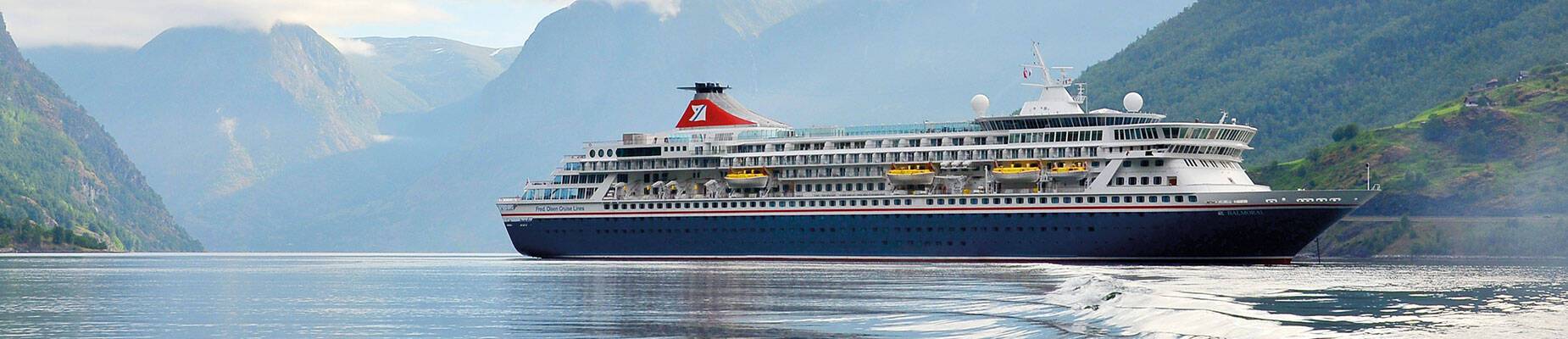
The second-largest ship in the Fred. Olsen Cruise Lines fleet is Balmoral, with a guest capacity of 1,275. In contrast, she is the smallest ship by gross tonnage. Despite her size, she still offers plenty of variety, with five restaurants, seven bars and lounges, two pools, and lovely wide-open decks that are perfect for scenic cruising. Speaking of which, like her fleetmates, her smaller size is suited to sailing narrow waterways and docking much closer to the heart of destinations that larger ships can’t reach. She can easily navigate the River Seine to reach destinations like Rouen, and the River Garonne to reach Bordeaux.
Originally built in 1988, she was welcomed by Fred. Olsen with open arms in 2007. In 2008, she underwent a major physical midsection extension, a “chop and stretch”, if you will. Because of this, the layout of her midship stairwell is structurally unique, and it was custom-built into a dedicated exhibition gallery displaying historical maritime trophies and Olsen family artefacts. Another unique feature of Balmoral is her crest, which proudly replicates the British royal family’s Scottish residence, Balmoral Castle.
Bolette: 1,273 guest capacity
Launched: 2000
The smallest ship in the fleet (but not too far behind Balmoral), Bolettewelcomes 1,273 guests aboard. As Fred. Olsen’s flagship, she leads the fleet of smaller ships by example and proudly bears the name of Fred. Olsen’s great-grandmother. She joined the fleet along with Borealis in 2020, after spending her life with Holland America Line. She was originally built in 2000, so she is also technically the newest Fred. Olsen ship.
In early 2026, she was refurbished during a 16-day dry dock which focused heavily on upgrading the guest experience. Her public lounges were refreshed, her dining options overhauled, her cabins upgraded, and her entertainment improved. One thing that remained untouched, though, was her 9-metre-tall chiming clock tower that proudly sits within her multi-level atrium. Designed by Gilbert Lebigre and Corinne Roger, the impressive custom mechanical clock tower, which is formally known as the Planeto Astrolabium, was inspired by a tiny 36-inch Flemish original.
Key takeaways from this blog post:
The Fred. Olsen Cruise Lines’ fleet comprises three ships, all of which fit perfectly into the small ship category
The largest ship in the fleet by guest capacity is Borealis, and by gross tonnage is Bolette
Each ship has unique features that can’t be found on fleetmates, like Borealis’ pediluvium foot spa, Balmoral’s trophy staircase and Bolette’s 9-metre clock tower
Borealis and Bolette have most recently been refurbished in October 2025 and January 2026, respectively
Bolette is the smallest ship in the fleet, but as the flagship, she leads by example